How a submarine dives and surfaces
How a steel boat weighing thousands of tonnes slips under the waves, hangs at depth and comes back up. The whole secret is a weight you can change: tanks take in sea water and blow it out with compressed air. A submarine in 3D and live diagrams, from the surface to the bottom of the Mariana Trench.

Inside the boat
A submarine sinks and rises without changing its shape or size. It changes its weight instead: to dive, it lets sea water into its tanks; to surface, it blows the water out with compressed air. Here is a model boat 100 metres long and 10 metres across, about the size of a nuclear attack submarine. The chapter numbers are depths: we will dive with it and finish on the floor of the deepest trench in the ocean.
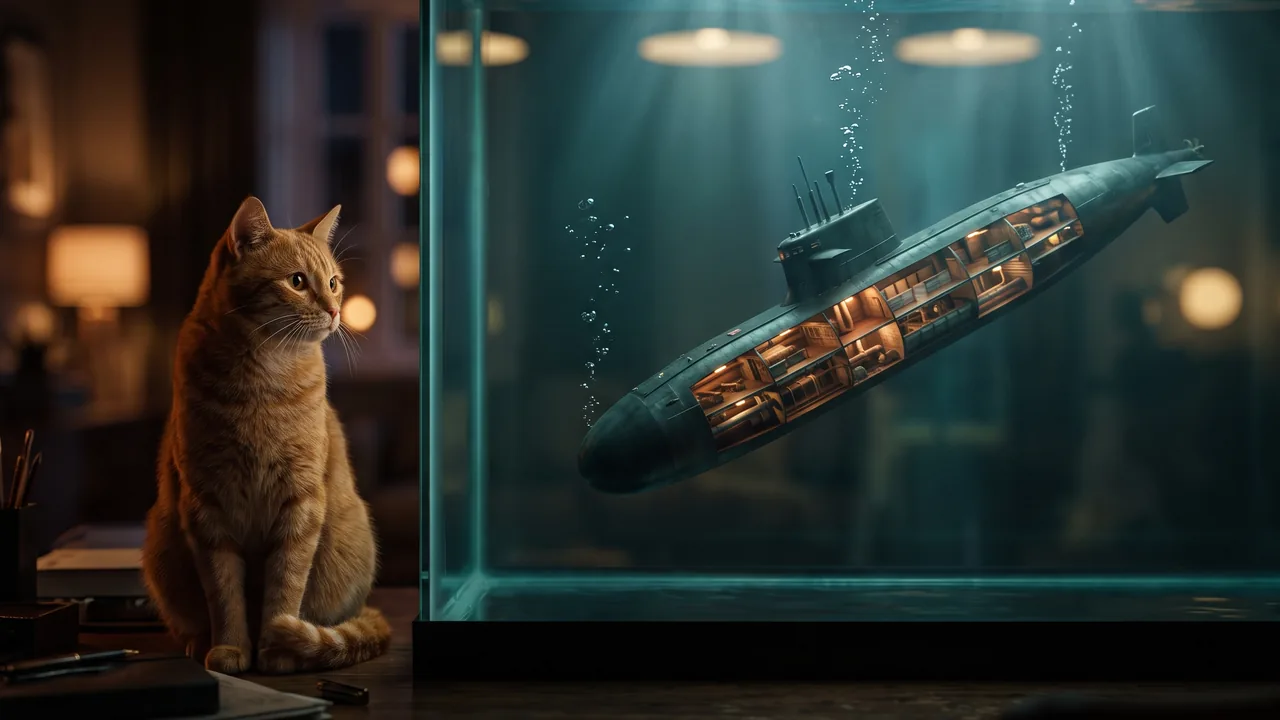
The key is the two hulls. Inside is the pressure hull, a steel cylinder that withstands the pressure of the water. The crew lives in it, along with the machinery. Outside is the light hull, a thin streamlined skin. The space between them is divided into main ballast tanks: they have openings at the bottom where the water comes in and vent valves at the top. While the tanks are full of air, the boat floats. Open the vents, and the air escapes, water flows in from below, and the boat goes under.
Why steel floats
A cubic metre of steel weighs 7.85 tonnes and, of course, sinks. So why doesn’t a boat weighing thousands of tonnes sink too? It is all down to Archimedes’ principle: a body in water feels an upward force equal to the weight of the water that would fill its volume.
Where does that force come from? Water presses on a body from every side, and the deeper, the harder: every metre of sea water adds a pressure of 1,025 kilograms per square metre. The bottom face of a cube is a metre deeper than its top face, so it is pushed harder, and the difference pushes the cube up. For a cubic metre it is 1,025 kilograms at any depth.
Now make a hollow box of the same size out of steel, with walls 2 centimetres thick. It weighs only 905 kilograms, less than a cubic metre of water, and floats 88 % under. Pour in 117 litres of water and the box will hang in mid-water. A little more, and it sinks. A submarine works the same way: it changes its weight without changing its volume.
Diving
On the surface a boat displaces less water than it could: part of its hull is above the waves. The volume of the main ballast tanks, full of air, is called reserve buoyancy. Double-hull boats, the traditional Russian design, have about 25–30 % of their weight in reserve; single-hull boats like the American ones, with tanks only at the bow and the stern, have about 10–15 %. A large reserve helps a boat survive damage on the surface; a small one lets it dive faster.
To dive, the crew opens the vent valves on top of the tanks. The air bursts out, sea water comes in from below through the open flood holes, and the boat gets heavier, settles lower, and the sea closes over it. With full tanks it weighs almost exactly as much as the water it displaces, and the diving planes take it down while it moves. The first stop is periscope depth, about 18 metres: only the periscope and antennas stick out of the water.
To surface, the vents are shut and high-pressure air from bottles is blown into the tanks. It pushes the water out through the openings at the bottom, the boat becomes lighter and rises.
Balance
Under water it is not enough for a boat to get heavier: its weight must exactly match the weight of the water it displaces. Then it hangs at depth: this is neutral buoyancy. During a patrol the boat burns fuel, eats its food, uses fresh water and fires torpedoes, and the density of the sea changes from place to place. Each change is made up by the compensating tank: sea water is taken into it or pumped overboard.
Balance along the boat matters too. Under water the centre of gravity must lie below the point where the buoyant force acts, the centre of buoyancy. But only a little below it, in our boat by 35 centimetres, so the boat is easy to tip. If twenty sailors walk from the stern to the bow, the boat tips bow-down by two degrees. This tilt is called trim, and it is levelled by pumping water between the forward and after trim tanks.
Diving planes
Under way, a submarine changes depth the way an aircraft changes height. It has diving planes for that, at the bow and at the stern. The stern planes tilt the whole boat so that it goes down or up at an angle; the bow planes push the bow up or down. Planes work on the water flowing past them, and their force grows with the square of the speed: twice as fast, four times as strong.
At a few knots the planes are almost useless, and the depth is held by the tanks alone. At high speed the boat answers the slightest touch of the planes, so the planesmen handle them very gently.
Layers of water
Neutral buoyancy is a fragile balance, because sea water is not the same everywhere. Warm and fresh water is lighter, cold and salty water is heavier. Below a warm upper layer there is often a thermocline, where the temperature drops sharply and the density rises. A boat balanced above it sinks into the denser water, becomes lighter than its surroundings and stops. Russian submariners call such a layer a “liquid bottom”: a boat can hang on it with its engines stopped.
It works the other way too. In lighter water, near the mouth of a big river for instance, a boat suddenly becomes heavy and drops. And the pressure hull is squeezed a little at depth, more than the water itself. So the deeper a boat goes, the heavier it gets, and on the way down water is pumped out of the compensating tank.
Pressure
Every 10 metres of water add about one atmosphere of pressure. At 300 metres the pressure is about 31 atmospheres: every square metre of the hull carries 300 tonnes, as much as a dozen loaded dump trucks.
Air changes with depth too. By Boyle’s law the volume of a gas is inversely proportional to its pressure: at 10 metres air is squeezed to half its volume, at 300 metres to a thirty-first. That is why blowing the tanks at depth is hard. Pushing a cubic metre of water out at 300 metres takes 31 times more air than at the surface, and the high-pressure air is kept in bottles at 200–300 atmospheres, so the supply is limited.
Emergency surfacing
If water floods into the boat, the crew performs an emergency blow: high-pressure air goes into all the main ballast tanks at once. At depth the air is compressed, so at first the boat gains only a little buoyancy. But as it rises the air expands and pushes out more and more water, so the ascent speeds up, and the boat bursts out of the sea, sometimes leaping bow-first out of the water.
The crew’s lives depend on this system. On 10 April 1963 the American nuclear submarine Thresher was lost during deep-diving trials. Most likely a pipe burst in the engine room, the reactor shut down, and the tanks could not be blown: air cools sharply as it expands, and the moisture in it froze in the strainers. All 129 people aboard died. After that the US Navy introduced its SUBSAFE safety programme.
The pressure hull
The deeper a boat must go, the thicker the walls of its pressure hull. But a thick hull is heavy, and the whole boat cannot weigh more than the water it displaces. For a cylinder this gives a simple rule: the hull’s share of that weight grows in proportion to the depth and the density of the metal and falls with its strength. A steel hull built for several kilometres would outweigh the water it displaces, leaving no weight for anything else.
That is why deep-diving boats are built of titanium: for the same strength it is almost half as heavy as steel. The Soviet submarine K-278 Komsomolets, with a titanium hull, was rated for 1,000 metres and dived to 1,027 metres on 4 August 1985. This is the record for a combat submarine. Most submarines operate at a few hundred metres.
A sphere is better still: for the same strength it is lighter than a cylinder. That is why the crew compartments of deep submersibles are spheres.
To the bottom of the ocean
The deepest place in the ocean is the Challenger Deep in the Mariana Trench, about 10,935 metres down. The pressure there is over a thousand atmospheres. Blowing tanks with air is impossible at such a depth, so deep submersibles surface differently: they drop weight.
On 23 January 1960 Jacques Piccard and Don Walsh reached the floor of the Deep in the bathyscaphe Trieste. Its steel crew sphere, 2.2 metres across with walls 12.7 to 17.8 centimetres thick, hung under a float holding about 130,000 litres of aviation petrol. Petrol is lighter than water and, unlike a gas, compresses very little, but still more than water. So on the way down the bathyscaphe slowly grew heavier, and the pilots dropped steel shot held by electromagnets, about a tonne for every 900 metres. To start the dive, water was let into the float’s ballast tanks; to come back up, they dropped about two more tonnes of shot. The descent took almost five hours, they spent 20 minutes on the bottom, and the ascent took three and a half hours.