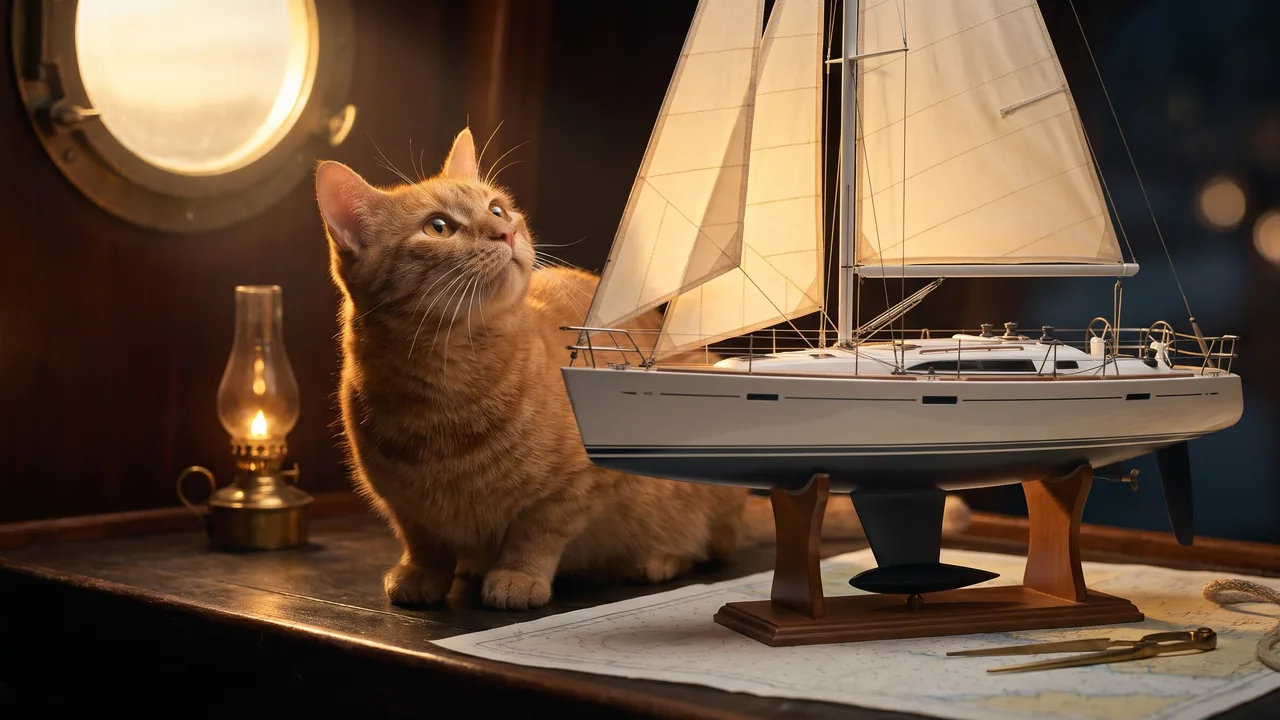
Anatomy of a sailing yacht
At the bottom of a yacht there is a hull with a keel, at the top a mast with sails, and in between dozens of lines and wires, each with its own name. Let’s climb a twelve-metre yacht from the keel under the water to the top of the mast and learn what sailors call every part on the way.

Yacht
Take an ordinary cruising yacht, the kind people charter for a sailing holiday: 12 metres long, 4 metres wide, weighing about 8.5 tonnes. It has one mast and two sails: the big mainsail behind the mast and the jib in front of it. A yacht rigged like this is called a sloop.
The chapter numbers are heights above the water. We start under water, with the keel 2.1 metres down, and climb to the top of the mast at 17.5 metres: the height of a six-storey building.
Everything on a yacht falls into a few families. The hull is the boat itself. Under it are the keel and the rudder. Above the deck stand the spars: the mast and the boom. The mast is held up by steel wires, the standing rigging, while the sails are hoisted and adjusted with lines that move, the running rigging.
Why so many special words? On deck, in the wind and the noise, the crew has to understand each other at once. “Ease the jib sheet” can mean only one thing; “let go of that rope over there” can mean several. And these are the words sailors use all over the world: at charter bases, in sailing schools and on the radio.
Keel
The lowest part of the yacht is the keel: a heavy fin under the hull. On our yacht it reaches 2.1 metres below the water. That is its draught / draft (the British and the American spelling): in any shallower water the yacht runs aground. The keel itself is the ballast: about 2.5 tonnes of cast iron or lead, more than a quarter of the weight of the whole yacht. Its heaviest part is at the very bottom, in a thick bulb, which is why this shape is called a bulb keel.
The keel has two jobs. The first is to stop the yacht capsizing. The wind presses on the sails and tips the yacht over to one side; this lean is called heel. The more the yacht heels, the further out to the side the heavy ballast swings and the harder it pulls the yacht back upright. A good cruising yacht comes back up even if a gust or a wave knocks it flat with its mast in the water.
The second job is to stop the yacht sliding sideways. Much of the wind’s push on the sails is sideways, and the keel grips the water like the fin of a fish. Without it the yacht would simply be blown downwind. How that push turns into forward motion, even against the wind, is the subject of the next lesson.
Rudder
Behind the keel, near the stern, the rudder hangs under the water: a flat blade that turns on a vertical shaft, the rudder stock. Turn the blade and the water presses on its side: the stern swings one way and the bow the other. A rudder only works when the yacht is moving: if it stands still, no water flows past the blade and there is nothing to steer with. Many modern yachts with a wide stern have two rudders, one towards each side; they turn together and work in just the same way.
There are two ways to turn the rudder. On small yachts a lever, the tiller, is fixed straight to the rudder stock. A tiller works backwards: push it left and the bow goes right. Bigger yachts like ours have a wheel, which works like the steering wheel of a car: turn it right and the yacht turns right. The tiller or wheel is the helm, and the person steering is the helmsman: they are “at the helm”.
Hull
Where the hull meets the water runs the waterline. The front end of the yacht is the bow, the back end is the stern, and the flat back face of the stern is the transom. Stand facing the bow: the side on your right is starboard, the side on your left is port. That never changes: whichever way you turn, the yacht’s starboard side is still starboard.
The words are old. Long ago ships were steered with a big oar over the right-hand side, and in Old English that was steorbord, “the steering side”. To avoid breaking the oar against the quay, ships came alongside with their left side to the shore. At first that side was called larboard, but larboard and starboard were far too easy to mix up, so it was renamed port: the side that lay against the quay in port.
At night you tell the sides apart by their lights: green on starboard, red on port. Two tricks help you remember: port and left both have four letters, and port wine is red. Put together: “Is there any red port left?”
Just as important are the windward side, the one the wind blows onto, and the leeward side, the one opposite. Sailors say leeward as “LOO-erd”. These two swap over when the yacht turns far enough for the wind to come onto the other side, and many rules of the sea are written in terms of them: for example, which of two sailing yachts must keep out of the other’s way.
Deck
The side of our yacht rises about 1.2 metres above the water; that height is the freeboard. On top lies the deck. Near the stern there is a well sunk into the deck, the cockpit. This is where the helmsman and the crew sit, and where the wheel, the instruments and nearly all the lines are. From the cockpit the companionway leads below, to the cabins.
Along the edge of the deck stand posts, the stanchions, with wires run between them, the guardwires / lifelines. Together they make a fence that keeps you from falling overboard. At the bow and the stern, instead of wires, there are strong tubular rails: the pulpit at the bow and the pushpit / stern pulpit at the stern.
By the cockpit stand the winches: drums with a handle. Wrap a line round the drum and pulling becomes dozens of times easier. Next to them are the clutches, which grip a line and hold it, and the cleats, where a line is made fast by winding it criss-cross over the horns of the cleat.
Boom and sails
Above the cockpit, at about the head height of someone standing, runs the boom: a horizontal tube hinged to the mast. The bottom edge of the mainsail is stretched along it. When the yacht turns its stern through the wind, the boom swings across from one side to the other, hard and fast. So the first rule in the cockpit is: always know where the boom is, and never stand up under it.
The mainsail sits behind the mast, on the boom. In front of the mast, on the wire that runs from high up the mast down to the bow, sits the jib. A sail set in front of the mast is a headsail, and a headsail so big that it reaches back past the mast is called a genoa, after the Italian city. On charter yachts the headsail is usually left in place: instead of coming down, it rolls up round the forestay like a blind on a roller, and the gear that does this is the roller furler.
A triangular sail has three corners. The top one is the head: the sail is hoisted by it. The bottom front corner is the tack, fixed at the mast or at the bow. The bottom back corner is the clew: the sheet that adjusts the sail is attached to it. The three edges have names too: the front edge is the luff, the back edge is the leech and the bottom edge is the foot. The leech of a mainsail usually has battens slid into it: flexible strips that hold its shape. A mainsail that rolls away inside the mast, with in-mast furling, has no horizontal battens.
Shrouds and stays
Our yacht’s mast is an aluminium tube as tall as a five-storey building. It can’t stand up on its own: tensioned steel wires hold it up. They don’t move while the yacht is sailing, which is why they are called the standing rigging.
The forestay pulls the mast forward, towards the bow; the jib is set on it. The backstay pulls it back, towards the stern. The shrouds hold the mast from the sides. To make the shrouds meet the mast at a wider angle, struts called spreaders push them outwards; on our yacht the first pair is about 8 metres above the water. At the bottom the shrouds are fixed to the hull by steel plates, the chainplates.
If any of these wires breaks, the mast can come down. That is why the skipper checks the rigging before setting out: looking for broken strands in the wires and for split pins / cotter pins that have been bent open.
Halyards and sheets
At the top of the mast, the masthead, there are sheaves: small pulley wheels that the halyards run over. A halyard hoists a sail: pull the halyard at the mast or in the cockpit, and the head of the sail climbs up. The masthead also carries the windex, a little vane that shows where the wind is coming from, as well as the wind sensor, the radio aerial and the lights.
The lines that adjust the sails as you sail are the sheets. The mainsheet holds the boom, and the mainsail with it; the jib sheets, one on each side, hold the clew of the jib. To sheet in is to pull the sail in towards the yacht; to ease is to let it out. Halyards, sheets and the other lines that move are the running rigging.
In short: a halyard goes up, a sheet goes sideways. And one more thing: sailors hardly ever say “rope”. Rope is what you buy on a reel; once it is on board and has a job to do, it becomes a line, and every line has its own name.
That is the whole yacht. Down below, the keel keeps it upright and stops it sliding sideways, and the rudder steers; the shrouds and stays hold up the mast, the halyards hoist the sails and the sheets adjust them. In the next lesson we take on the great puzzle of sailing: how a yacht can sail against the wind.
Terms in this lesson
| Term | What it is |
|---|---|
| hull | the body of the boat, the shell that floats |
| deck | the top surface of the hull, the part you walk on |
| keel | the heavy fin under the hull that keeps the yacht upright and stops it sliding sideways |
| rudder | the blade under the stern that steers the yacht |
| mast | the tall upright spar that carries the sails |
| boom | the horizontal spar along the bottom of the mainsail, hinged to the mast |
| standing rigging | the fixed steel wires that hold the mast up |
| shrouds | the wires that hold the mast from the sides |
| forestay | the wire from high up the mast to the bow; the jib is set on it |
| backstay | the wire from the top of the mast to the stern |
| running rigging | the lines that move: halyards, sheets and the rest |
| halyard | the line that hoists a sail |
| sheet | the line that pulls a sail in or lets it out |
| mainsail | the big sail behind the mast, set on the boom |
| jib | the sail in front of the mast, set on the forestay |
| genoa | a big headsail that reaches back past the mast |
| bow | the front end of the yacht |
| stern | the back end of the yacht |
| starboard | the right-hand side, facing the bow; its light is green |
| port | the left-hand side, facing the bow; its light is red |
| cockpit | the well near the stern where the crew sits and steers |
| head | the top corner of a sail |
| tack | the bottom front corner of a sail |
| clew | the bottom back corner of a sail, where the sheet is attached |
| luff | the front edge of a sail |
| leech | the back edge of a sail |
| foot | the bottom edge of a sail |
| battens | flexible strips in the leech that hold the sail’s shape |
Test yourself
1. A yacht is sailing at night and you can see its red light. Which side of it is facing you?
The red light is on the port side, the green one on starboard.
2. What do you hoist a sail with?
A halyard goes up, a sheet goes sideways. The forestay is a fixed wire that the jib is set on.
3. You push the tiller to the left. Which way does the bow go?
A tiller works backwards: hand to the left, bow to the right. A wheel works like a car’s steering wheel.
4. What is the bottom back corner of a sail, where the sheet is attached, called?
The sheet is attached to the clew. The head is the top corner, the tack the bottom front one.
5. What holds the mast from the front?
The forestay pulls the mast towards the bow, the backstay towards the stern, and the shrouds hold it from the sides.
6. You are facing the bow and the wind is on your right cheek. Which side is windward?
Windward is the side the wind blows onto. Wind from the right means the starboard side is windward.
Try it at a marina
- Walk along the pontoons and find the bow, the stern, the transom and the starboard side of three yachts. If a yacht has two wheels, its cockpit is wide; many such yachts also have two rudders, one towards each side.
- On any yacht, follow the forestay, the backstay and the shrouds with your eyes, from the top of the mast to where they are fixed to the hull. Count the spreaders.
- Find the halyards at the mast, and in the cockpit the mainsheet and the two jib sheets. See which winches and clutches they are led to.
- Look at the windex at the top of the mast and say where the wind is coming from and which side of the yacht is windward right now.