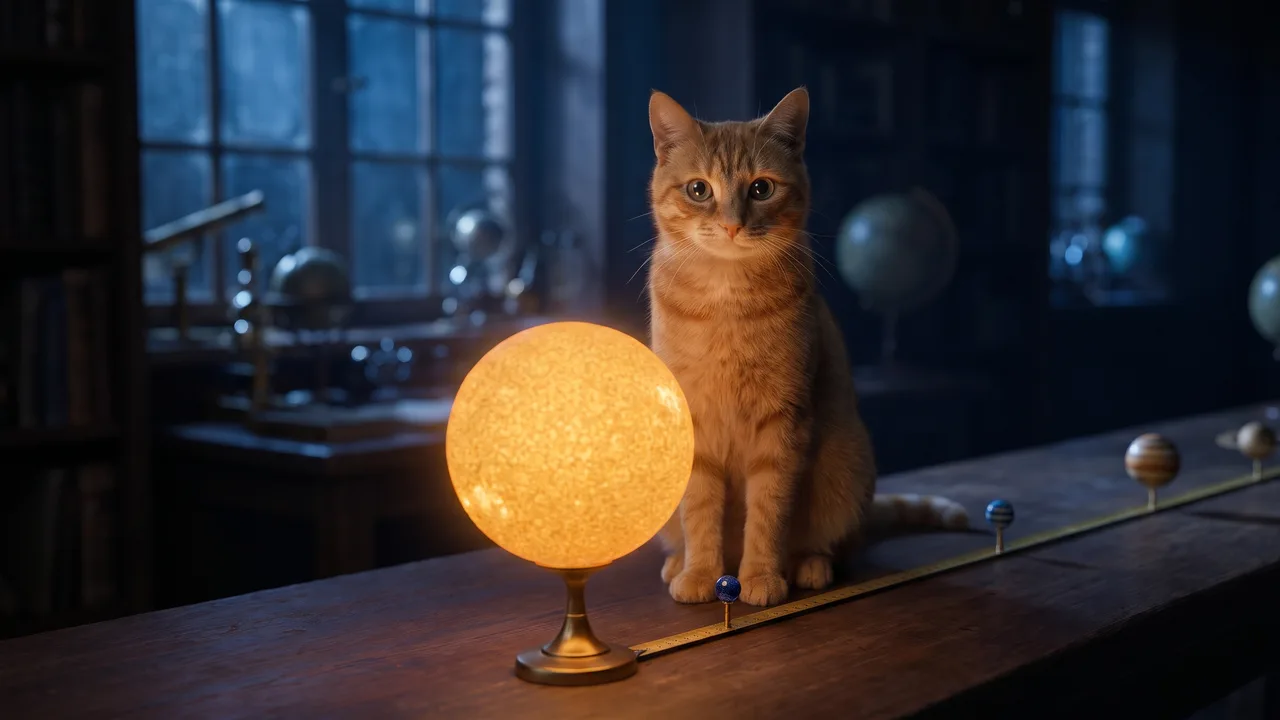
The Solar System to scale
Almost every picture of the Solar System is wrong, or you would not see a thing in it. Here is what it really looks like: planets and distances to one scale, with sunlight crawling out at its real speed.

Scale
In a textbook the Solar System fits on two pages: a big Sun with eight little balls on neat orbits next to it. It is a convenient fib. The distances between the planets are thousands of times larger than the planets themselves, and an honest picture is almost empty. The chapter numbers in this explainer are how long sunlight takes to reach the place the chapter is about: from zero at the Sun itself to more than four years at the nearest star.
Two scales at once get in the way of an honest drawing. In size, the Sun is 109 times wider than the Earth and Jupiter is 11 times wider. In distance, you could line up 11,700 Earths between the Earth and the Sun, and 350,000 on the way to Neptune. Shrink everything so that Neptune’s orbit fits on your screen, and the Earth becomes hundreds of times smaller than a pixel; even the Sun is less than one pixel.
Artists get round it simply: they make the planets bigger and move them closer to the Sun. Try enlarging everything by the same factor, without cheating. At 215 times the Sun already reaches the Earth’s orbit, while the Earth itself is still a dot smaller than a pixel.
Light
Nothing is faster than light: 299,792 kilometres a second. In one second light could go round the Earth’s equator seven and a half times. Light from the Moon takes 1.3 seconds to reach us, and from the Sun 8 minutes 19 seconds. We see the Sun as it was eight minutes ago.
The distance from the Earth to the Sun, about 149.6 million kilometres, is the yardstick of astronomy: the astronomical unit, au. Since 2012 it has been fixed exactly at 149,597,870,700 metres. Mercury is 0.39 au from the Sun and sunlight gets there in 3 minutes 13 seconds; Mars is 1.52 au away, and light takes 12 minutes 40 seconds.
In the diagram below the distances are real and light moves at its real speed. Make a flash on the Sun and watch: the fastest thing in the universe barely crawls across the screen. It will reach the Earth in eight minutes. If you would rather not wait, speed up the clock.
Sizes
Sunlight reaches Jupiter in 43 minutes. Jupiter is the biggest planet: 11 times wider than the Earth and 1,300 times its volume, and it holds two and a half times as much mass as all the other planets put together. Yet next to the Sun even Jupiter is small: the Sun is 10 times wider. By volume the Sun is 1.3 million times the Earth, and it holds 99.86 % of all the matter in the Solar System.
A popular picture shows all the planets in a row fitting between the Earth and the Moon. It is true, but not always. The seven planets add up to 380,000 kilometres across, while the gap between the surfaces of the Earth and the Moon is about 376,000 kilometres on average. The row does not fit. But the Moon moves on an ellipse, and its distance from the Earth changes from 356,000 to 407,000 kilometres. When the Moon is far away, the planets fit with room to spare.
Emptiness
After 4 hours 10 minutes sunlight reaches Neptune, the last planet, 30 times farther from the Sun than the Earth. To get a feel for distances like that, shrink the Sun to a 22-centimetre football. Then the Earth is a 2-millimetre peppercorn 24 metres from the ball. Jupiter is a 2-centimetre cherry 123 metres away, and Neptune an 8-millimetre pea 711 metres away. The model takes up a town district almost a mile across, and all of it is empty.
Emptiness is what the Solar System is mostly made of. The Sun and all the planets together fill one 270-billionth of a ball the size of Neptune’s orbit. In the football model, light crawls along at 5 centimetres a second: it needs four hours to reach Neptune, while you could walk there in about ten minutes.
Even the asteroid belt, drawn in films as an avalanche of rocks, is nearly empty. All its rocks together weigh about 3 % of the Moon, and almost 40 % of that is Ceres alone. There are 1 to 2 million asteroids over a kilometre across, but neighbours are 2 to 3 million kilometres apart on average, several times the distance from the Earth to the Moon. Spacecraft fly straight through without dodging; Pioneer 10 was the first to do it, in 1972–1973.
Voyager
In a day light travels 25.9 billion kilometres, or 173 au. That is how far from the Earth the most distant object ever made by people is now: on 18 November 2026 Voyager 1 became the first to reach one light-day from us. A command from the Earth now takes more than a day to reach it, and the answer comes two days after it was sent.
Voyager 1 was launched on 5 September 1977. It flew past Jupiter and Saturn and headed north, out of the plane of the planets. In 2012, 121.6 au from the Sun, it crossed the heliopause, the boundary where the solar wind runs into interstellar gas. Voyager 1 is now moving away from the Sun at 17 kilometres a second, 3.6 au a year. Its twin Voyager 2 crossed the heliopause in 2018 and flies a little slower.
Beyond lies the Oort cloud, a vast swarm of icy bodies where long-period comets come from. Nobody has seen it; we know it from the orbits of comets. By current estimates it starts 2,000 to 5,000 au from the Sun and ends somewhere between 10,000 and 100,000 au, perhaps a third of the way to the nearest star. Even its near edge, at 2,000 au, is still some 500 years away for Voyager 1, and crossing the cloud would take tens of thousands of years.
Stars
The nearest star to the Sun is Proxima Centauri, a small red dwarf. Its light takes 4.2 years to reach us: that is 268,000 au, or 40 trillion kilometres. Next to it, 4.3 light years away, are the two bright stars Alpha Centauri A and B. In the model with a football for the Sun, Proxima would be 6,350 kilometres away, about the distance from London to Chicago.
Voyager 1 would need 75,000 years to get to Proxima, if it were heading there. It is not: the first star on its path is the red dwarf Gliese 445, and in about 44,000 years Voyager will pass it at 1.9 light years. The stars around us are scattered as sparsely as the planets around the Sun: within ten light years there are only about a dozen star systems.
The Solar System to scale is, above all, emptiness: tiny balls hours of light apart, and stars years apart. That is why pictures always get it wrong. Otherwise they would have to show emptiness.