How a steam engine and a steam locomotive work
Fire boils water, steam pushes a piston, and a machine of a hundred tonnes hauls a train of several thousand. Let’s take a locomotive apart in 3D and climb the scale of steam pressure: from a cold boiler and Newcomen’s atmospheric engine to the turbine of a modern power station.

Locomotive
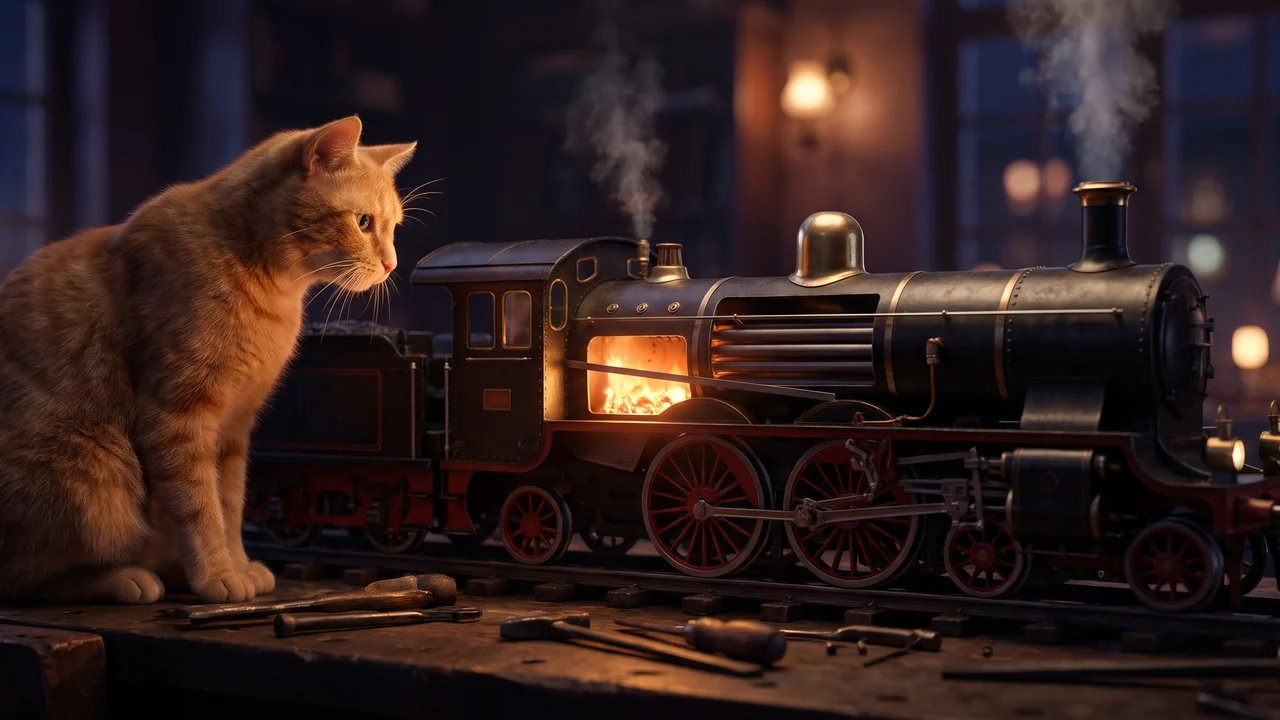
A steam locomotive is a boiler on wheels. The fire in the firebox boils water, the steam under pressure pushes the pistons, and the pistons turn the wheels through the rods. The chapter numbers are the steam pressure on the gauge. On a cold engine the needle sits at zero, and we will finish at 250 bar: that is what the boilers of modern power stations hold.
Everything is built around one chain. Coal burns in the firebox, and the hot gases pass through the boiler in the fire tubes, giving their heat to the water. The steam collects at the top, in the steam dome, where the regulator sits: the main valve of the engine. From there the steam goes to the cylinders, the valve lets it in on one side of the piston, then on the other, and the spent steam shoots up the chimney and fans the fire.
The whole trick is that steam takes up far more room than the water it came from. At ordinary pressure a litre of water makes almost 1,700 litres of steam. Locked in a boiler, the steam presses on the walls, and that pressure can be turned into motion.
Vacuum
The first steam engine that kept working for years was built by Thomas Newcomen in 1712 near Dudley Castle in England. It pumped water out of a coal mine. The steam in its boiler was only a touch stronger than the atmosphere: about 0.07 bar on the gauge, one pound per square inch. And it was not the steam that pushed the piston.
The cycle goes like this. The heavy pump rods outweigh the beam and lift the piston, and the cylinder fills with steam. Then cold water is sprayed inside. The steam condenses, shrinking hundreds of times, and almost a vacuum is left under the piston. From above, the atmosphere presses on the piston: more than 10 tonnes-force on every square metre. The piston goes down, the beam rocks and lifts water from the mine.
Newcomen’s engine made about 12 strokes a minute and developed about 5.5 horsepower. Nearly all the coal was wasted: less than one per cent of its energy became work. But at the pit head coal cost next to nothing, and such engines were built for more than half a century, with ever wider cylinders.
Condenser
In 1763 James Watt, instrument maker at the University of Glasgow, was given a model Newcomen engine to repair. He noticed that most of the steam went into heating the cylinder again after the cold water had chilled it. Early in 1765 Watt came up with the separate condenser: the steam goes off to condense in a separate cold vessel, and the cylinder stays hot all the time. He got his patent in 1769.
Boulton and Watt engines burnt about four times less coal for the same work. Their steam stayed weak, a pound or so per square inch above the atmosphere, about 0.1 bar: Watt was afraid of high pressure. The work was still done mostly by the vacuum in the condenser. Later Watt built a double-acting engine, where steam pushes the piston from both sides, and taught it to turn a shaft. And to sell his engines he brought in a unit of power, the horsepower, about 746 watts.
Pressure cooker
A pressure cooker holds about 1 bar on the gauge, and the water in it boils not at 100 but at about 120 °C. The higher the pressure, the hotter the boiling water and the denser the steam. Denis Papin knew this already: in 1679 he showed his “digester”, a sealed pot in which even bones went soft, and in 1681 he described a safety valve for it, held shut by a weight on a lever.
For an engine this means the following. At 13.7 bar, as in the boiler of the class L, steam takes up not 1,700 but 134 times the volume of the water, yet it pushes on the piston 13.5 times harder than the atmosphere. With strong steam the engine becomes small and light, and it can be put on wheels. Richard Trevithick was the first to do so: in 1804 his locomotive carried 10 tonnes of iron and 70 men along a tramway in Wales. He needed no condenser: the spent steam was simply let out up the chimney.
Strong steam has a dark side. A boiler stores an enormous amount of heat, and if a wall gives way, the superheated water flashes into steam at once and blows the boiler apart. That is why every boiler carries a safety valve.
Boiler
In October 1829, at Rainhill, a locomotive was chosen for the first inter-city railway, Liverpool to Manchester. The winner was the Rocket of George and Robert Stephenson, with a boiler at 50 pounds per square inch, about 3.4 bar. Its main novelties were in the boiler.
The first was fire tubes. The hot gases went not through one wide flue but through 25 narrow copper tubes. Split the same cross-section into 25 tubes, and their surface grows 5 times, the square root of 25. The more surface, the more heat reaches the water and the more steam. The second was a separate firebox in a water jacket. The third was the blastpipe: the spent steam shoots up the chimney through a nozzle and, like a pump, draws air through the fire. The harder the engine works, the stronger the draught and the hotter the fire: the boiler adjusts itself to the load.
This layout, firebox, tubes and smokebox with a blastpipe, stayed with locomotives to the very end. Only the big engines of the 20th century had one or two hundred tubes.
Valve
The most numerous locomotive of tsarist Russia was the “Ovechka”, the “little sheep” of class O: of the Ov type alone 4,175 were built between 1901 and 1928. Its boiler held 12 atmospheres, 11.8 bar.
The heart of a steam engine is a cylinder with its valve. The piston here is double-acting: steam pushes it from one side, then from the other, and both strokes do work. The steam is shared out by the slide valve, a box that slides over the ports of the cylinder. This D-shaped slide valve was invented by William Murdoch, Boulton and Watt’s engineer, and went into a patent of 1799.
The valve moves to and fro with the wheel, but a quarter of a turn ahead of the piston. As the piston comes to the end of its stroke, the valve is already opening the port on that side to fresh steam and connecting the other end of the cylinder, through its hollow, to the exhaust. While the port is open, steam is admitted. Then the valve closes the port. That is the cut-off, and the trapped steam goes on working by itself as it expands. At the end of the stroke the port opens to the exhaust. Each end of the cylinder blows out steam once per turn of the wheel, so an ordinary two-cylinder locomotive gives four beats per turn: the familiar “chuff-chuff”.
Cut-off
The class L was the most numerous Soviet locomotive of the post-war years: more than four thousand were built between 1945 and 1955. The boiler pressure was 14 atmospheres, that is 14 kgf/cm², or 13.7 bar. On a piston 65 centimetres across such steam pushes with a force of 46 tonnes.
But letting steam in for the whole stroke is wasteful. The driver turns the reverser in the cab and changes the travel of the valve, and with it the moment of cut-off. When starting, steam is let in for almost the whole stroke, 75–85 %, to get the greatest force. Under way the cut-off is brought down to 15–30 %: after that the steam pushes the piston on its own as it expands. Each stroke does less work, but even less steam is used, and every kilogram of steam does more work. The same reverser puts the engine into reverse.
You can see this on the indicator diagram, a graph of the pressure in the cylinder against the position of the piston. The area of the loop is the work per stroke. Such diagrams were already taken on Watt’s engines, and later all steam engines were tuned by them.
Speed
On 3 July 1938 the British locomotive Mallard reached 126 miles an hour, 203 km/h, down Stoke Bank. It is still the speed record for steam. Its boiler pressure was 250 pounds per square inch, 17.2 bar, and its driving wheels were more than two metres across.
The wheels are turned by a crank and connecting rod: the rod joins the piston to a pin on the wheel, and the to-and-fro becomes rotation. A single cylinder has two dead centres: at the ends of the stroke the rod pulls straight along the crank and cannot turn the wheel. So there are at least two cylinders, and the cranks on the two sides are set a quarter of a turn apart: when one is at dead centre, the other pulls hardest. The other wheels are linked to the driving one by coupling rods and turn with it.
At record speed Mallard’s wheels made almost 9 turns a second, and each piston stopped and rushed back 18 times a second. The heavy rods and pins are balanced by counterweights in the wheels: those solid crescents between the spokes.
Grip
The Big Boy of the American Union Pacific is one of the largest locomotives ever built: 25 of them were made in 1941–1944. Pressure 300 pounds per square inch, 20.7 bar, four cylinders, more than 500 tonnes with the tender. They hauled heavy trains over the Wasatch mountains.
How do smooth wheels pull a train along smooth rails? By friction. A wheel can push the train with a force no greater than the weight on the driving wheels times the adhesion coefficient: for steel on dry, clean rails it is about 0.25, on wet rails about 0.17. So a locomotive is made heavy, and the force of the engine is matched to that limit. Give it more steam and the wheels slip. Sand from the sand dome under the wheels raises the grip to about a third of the weight.
On the other hand a train rolls very easily: steel on steel hardly gives, and on level track each tonne needs 1–2 kilograms-force. Big Boy’s pull, about 61 tonnes-force, would keep a train of tens of thousands of tonnes moving on the level. Gradients are the trouble: on a 1 % climb, 10 metres per kilometre, every tonne needs another 10 kilograms-force. That is why over the mountains Big Boy hauled trains of about 3,300 tonnes.
Turbine
A locomotive eats tonnes of coal, yet even at its best it turns only 6–8 % of the energy into work, and about 4 % on average over its life. Nearly all the rest goes up the chimney: with the hot gases and, above all, with the spent steam, which carries away the heat of evaporation. That is why in the middle of the 20th century steam gave way to diesel and electric traction. The USSR stopped building main-line steam locomotives in 1956, and China built industrial ones until 1999.
But steam has not gone anywhere. In 1884 Charles Parsons built a steam turbine: the steam does not push a piston, it spins blades. The best coal-fired units keep their steam at 250–290 bar and 600 °C, beyond the critical point of water, and turn 45 % of the energy of coal into electricity. Steam turbines drive the generators of coal and nuclear stations and make more than half of the world’s electricity, about 55 %.
That is the whole way. Fire turns water into steam, the steam presses, the valve lets it onto the piston in turn, the rod turns the wheels, and the grip on the rails pulls the train. And the higher the pressure and the longer the expansion, the more work comes out of the same coal.